
18–05–2018, Mumbai, India: It is a truth universally acknowledged, that a Muslim man in possession of a beard (or a woman in possession of hijab), must be in want of the answer to the perennial question of identities.

Good Morning Everyone. This is The Friday Post on a warm Friday morning. There is no Google doodle in India today and the holy month of Ramzan is upon us. Today seemed opportune to start the series and for my opening sentence, I could go no further than Jane Austen. The occasion also deserves a good subject and I could go no further than the question of identities which Muslims in India are continuously asked and reminded of explicitly and implicitly.
What is it?
In its simplest form, and casting all niceties and political correctness aside, am I first an Indian or a Muslim? The word “first” is the emphasised qualifier here.
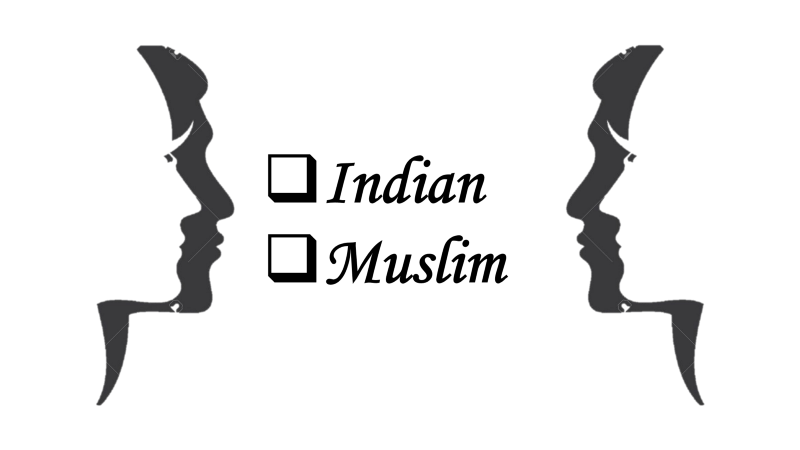
I remember writing a very long and meandering blog post on this topic as well as a short and succinct answer to this question on Quora. In today’s post, I won’t dwell on repudiating the question as a case of false dichotomies. Therefore, let me take some time and present my take on why this question is asked of us in the first place.
For the purpose of this discussion, I have kept my observations limited to Hindus and Muslims.
How it Started
Hindus and Muslims in India
Hindus and Muslims have lived in India together for about fourteen hundred years and understood each other through a series of interactions, not always peaceful. There is also a long history of Muslim rulers in various parts of the country before we finally gained our independence. A monarchy of the minority transitioning into majoritarian democracy resulted in a shifting of the balance of power. Both the communities resented this change. Thus, even though there is a spirit of general cooperation between the communities, trouble can be seen lurking, as they say, just behind the corner.
The Partition
Our independence was accompanied by an event that perhaps defined the future of the subcontinent — the partition. The country was divided into two — India and Pakistan. India constituted the regions with a majority of Hindus and Pakistan consisted the ones with a Muslim majority. While leaders across the board insisted everyone was free to reside wherever they pleased, the reality was different. A series of riots followed that saw many Muslims move to Pakistan and Hindus move to India. However, a large number couldn’t because of the huge emotional cost involved in leaving one’s home. There was also the logistical nightmare of uprooting one’s life and settling it somewhere else.
This is where it all started.
With the availability of another country — and an enemy one at that — where one could shift, the question of where one’s heart, and thus loyalty, lay was inevitable. Migration continued years after partition. The famous poet Josh Malihabadi migrated as late as 1958, much to Pandit Jawaharlal Nehru’s disapproval. Such a trend ensured that Muslims were always looked at with suspicion in India. They were suspected of having desires to migrate to Pakistan and were perceived as threats because, in the hypothetical scenario of them actually migrating, they would carry with them secrets that could be used against India. It’s another story that they were also branded Indian agents when some of them actually migrated to Pakistan.
This gives an idea as to why some Hindus, and maybe others too, questioned Indian Muslims’ patriotism. What is surprising is that this question is still asked of us seventy years later.
Why Today?
Indoctrination against Indian Muslims
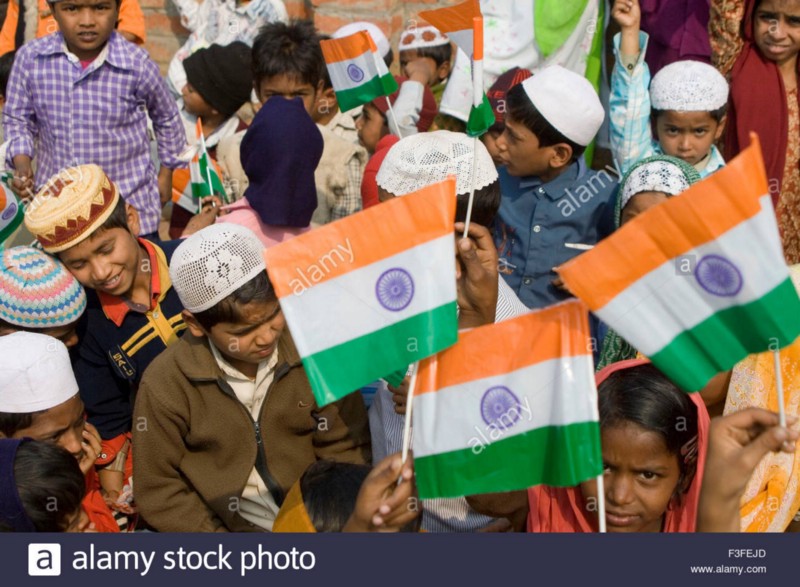
Among others, indoctrination is one reason why this question is still asked. When your parents question your Muslim neighbour’s commitment to your country, it’s hard to assume you won’t. You will misread the green crescent flag as the Pakistani flag. You will think slogans in a language you don’t understand are threats to your way of life. You see people who look different and so think of them as different from the average, which in your world, is you.
Indian and Hindu Culture
The bigger and more unrecognised reason this question exists is that Hinduism is even today seen as an Indian religion. With a large diaspora and spread of the Hindu faith through organisations like ISKCON, one can doubt this is entirely true. Yet, some people find it difficult to separate Hinduism from India. This makes them think of very distinct signs of Hindu religion like Saraswati Vandana as aspects of Indian culture. When a Muslim is found unaware of such aspects, he is seen as ignorant or disrespectful of the Indian culture. One, therefore, concludes that Muslims prefer their Muslim identity over their Indian one.
A large part of our lives is spent fending off these questions in our own heads and trying to find answers to them. I am instead trying to seek reasons for asking the question. I have just listed some that I could think of with a little context.
I will keep struggling with the same in the days to come but this is all in this Friday’s post. Till the next Friday, live long and prosper.
The article was first published here.
 A LAYMAN PERSPECTIVE