
08–06–2018, Mumbai, India: Whatever our DNAs are made of, his and mine are 12.5% same.

Good Morning Everyone. This is The Friday Post on a warm Friday Morning. The week before last, I was home due to a family emergency. I am still struggling to understand how this turned into the perfect occasion for my parents to bring up the topic of my marriage. Their first choice for me, of course, was my cousin.
Marrying a cousin is a staple for jokes on the Muslim community. Some of them have left me in splits. “Phupho ka laRka” or paternal aunt’s son as a potential bridegroom is a leitmotif that has been often employed. A Pakistani telefilm was centred around the theme. It has been the subject of writings like this one by Andaleeb Wajid. Popular Youtube artist Sham Idrees has also covered the subject in a skit.
A few friends have actually raised this question with me — How can you marry your own cousin? I have noticed two types of objections. The first is along the lines of relationships — the girl or boy is like your own brother? The second is about growing up — the girl or boy is someone you have grown up with and treated her or him as a sister or brother.
The Objections
“Like your brother/sister” objection
The first objection arises due to cultural insensitivity. The concept of Gotra — people who are descendants in an unbroken male line from a common male ancestor — is present in Hinduism which makes it theoretically exogamous. It creates problems of its own; many lovers who aren’t related by blood have been forced to, sometimes brutally, give up their love because they belonged to the same Gotra. Since a majority of Indians have grown up in an environment where cousins are treated as brothers and sisters, they expect Indian Muslims to also look at them the same way. The truth, however, is different. We are not brought up thinking up of our cousins as siblings. In fact, there is a certain “distance” we maintain with our cousins of the opposite sex once we grew up.
Not understanding that people can react differently to the same thing based on the culture they grow up in is cultural insensitivity. I have talked about this issue earlier as well. People fail to understand that what is an exception in their society can be a norm elsewhere.
“Grown up together” objection
The second issue is where people say that we have grown up as brothers and sisters and it would be inappropriate to marry after such an upbringing. I completely agree. However, marrying a cousin is only an option. It’s not a requirement. We don’t have to marry the cousins we have grown up with as brothers and sisters, and in my personal experience, we don’t. If someone does marry her or his cousin, it’s someone you are not really close to and haven’t shared a brotherly or sisterly relationship.
“Statistics, Statistics, and Damned Lies”
The Practice around the World
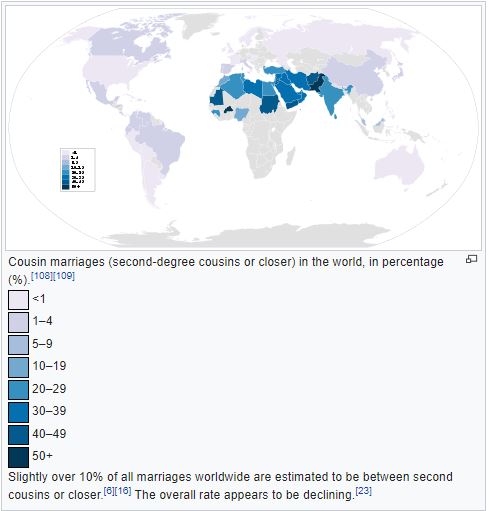
Almost 10% of the marriages in the world are consanguine. The practice is more common in countries with a predominance of Islamic culture but isn’t completely unknown in other cultures as well. There are many parts of the world — including China, Korea, and some states of US — where it is banned between first cousins. There are cultures which are okay with cross-cousins and then there are others where parallel-cousins are more accepted.

Historical Practice
Apparently, the taboo around cousin marriage is a new one the world over. Marriage within royalty as a means to cement bonds between royal families. Historically, communities have not been as large as they are today. Moreover, the search costs of potential spouses were too high and hence marriages tended to restricted in closer circles. Hence, it is assumed that about 80% of marriages all over history have been cousin marriages. It is only with the advent of technology and the population boom that cousin marriages have become taboo — somewhere around the 19th century.
There have been some very famous people in history who have wedded their cousins. Albert Einstein, Charles Darwin, Edgar Allan Poe and H. G. Wells are amongst people associated with their cousins at some point or the other. (Source 1, Source 2)
Medical Issues
One major objection raised against cousin marriage is that it leads to birth defects in the offspring. Islamophobe pages have used this very insensitively in the past to crack jokes at the expense of the Muslim community. This is not entirely false — studies have shown that the risk of birth defects increases by two times. The risk of a baby having birth defects increases from 3% to 6% when the marriage is between first cousins. However, the same jump in risk is seen while comparing the children born of a 30-year-old woman and a 40-year-old woman. The exaggerated effects of inbreeding that have been played out in the media do not find favour with the scientific community any longer.
Why Islamic Cultures practise Cousin Marriages
Why is there a prevalence of cousin marriages in Islamic cultures? This question has two answers — religious and cultural. The Middle East and North African tribes have historically been open to consanguineous marriages. Since a large part of the Muslim community lives in this area and has ties with the region, the cultural effect continues. The religious reason is also significant — a lot of prominent Islamic personalities have married within the family. The Prophet (Sallallaahualaihiwasallam) himself is reported to have married his cousin. The practice adopted by religious figures adds a sense of acceptability and also preference to cousin marriages even though there is no legal compulsion behind the same.
Stop making it an Issue

Stop looking at cousin-marriages as some sort of unholy arrangement just because it does not fit your definition of “normal” and does not fit your idea of Indian Culture. Indian culture is vastly more accommodating than our idea of homogeneous culturalism. Develop cultural sensitivity towards those who might be different from you. I will go back to convincing my parents why I don’t want to marry my cousin. Till then, live long and prosper.
This blog was also published here.
 A LAYMAN PERSPECTIVE