
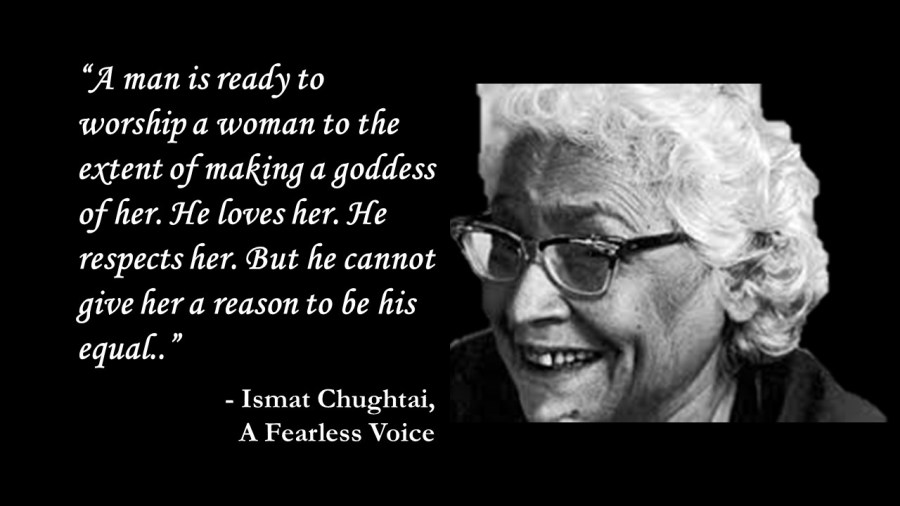
29–06–2018, Mumbai, India: A man is ready to worship a woman to the extent of making a goddess of her. He loves her. He respects her. But he cannot give her a reason to be his equal.
Good Morning Everyone. It’s the Friday Post on a warm Friday morning. A lot has been made of the “Triple Talaq” issue. This post does not discuss the Triple Talaq Issue. Instead, we discuss the reaction of Indian Muslims to it and how we are missing the woods for the trees.
The Basics of Triple Talaq
Divorce in Islam
Talaq means divorce. In Islam, a man has the right to divorce his wife. For a wife, there is the khula – where she can initiate a divorce. It has to be accepted by the husband or enforced by the law. In contrast, as stated earlier, a man can divorce his wife – her consent is not needed.
Triple Talaq
Triple talaq needs a bit of explanation. A man has to divorce his wife thrice for the divorce to take place. He can do it over a period of time or at one go. Divorcing one’s wife at one go is the subject of discussion here – it is seen as inhumane and misogynist. For such a divorce to take place, a man has to communicate to his wife thrice that he is divorcing her. Generally, saying the word talaq thrice to her would be the sentence for divorce.
Legal Opinion
There are two forms of legal opinion that I will point out – Islamic and Indian.
The Islamic opinion, like Islamic opinion on most contentious issues, is slightly diverse. There are multiple schools of thought and then there are differences among the scholars of a certain school. On the issue of triple talaq, traditional scholarship (old scholars of the mainstream schools) has maintained that three divorces pronounced at one go count as three. This makes the divorce binding. Other scholars have held that saying talaq thrice is technically just one and the husband will have to divorce his wife twice more in other periods of time. Hence, the divorce is not complete. This, in very brief, is the concept of triple talaq.
The Indian legal opinion on triple talaq had been the same as traditional Islamic scholarship. However, that changed in 2017. India’s Supreme Court banned the triple talaq practice about a year ago. It was celebrated by the government with the Prime Minister himself asking political parties across the spectrum to come together over the issue. The Muslim Women Bill of 2017 outlaws such a divorce by making them null and void. It also sanctions jail time for the erring husband.
“Judgment of the Hon’ble SC on Triple Talaq is historic. It grants equality to Muslim women and is a powerful measure for women empowerment.” – Narendra Modi, Prime Minister of India
The Reaction to the Bill by Muslim Groups
Both For and Against
The movement to outlaw the practice was launched by the Bharatiya Muslim Mahila Andolan. They hailed the verdict as an important one for Muslim women. However, other Muslim groups took it negatively, calling it a breach of Sharia and Muslim Personal Law.

The All India Muslim Personal Law Board was at the forefront of this. Demonstrations were held across the country with Muslim men and women calling the outlawing of triple talaq and against the Islamic law. Letters were signed but nothing came out of the movement.

Whether the ban on triple talaq changes the Islamic Law or not is a very unfruitful debate. It’s a change in the Indian law that affects the lives of Indian Muslims. Does this amount to changing the Islamic law?
- It does so because Indian Muslims will not be able to follow a particular law of their religion. Whether they need to or want to follow that law is out of scope as of now.
- It doesn’t because the change is in Indian law and not Islamic law. No one has changed any source of Islamic law.
People will choose, based on their prejudices, whichever side they want to take.
The rest of this article will talk of things I really want to talk about – why triple talaq is not the only violation of Islamic law we Indian Muslims should be worried about when it comes to the rights of Indian Muslim Women. There are many other issues that need to be addressed and it would be a welcome move to address them. It would great for our leaders – political and religious – to take them up from the podium and the pulpit.
Issues Muslim Women Face
What follows is mostly a personal assessment – not backed by scientific research and numbers. What I talk of is very personal. The issues I talk of are my observations from having lived a very large part of my life in Eastern India and the plains. They also include my observations from travelling and staying in many places across Northern, Western, and Southern India. They are also borne out of my interactions with friends – Muslims and non-Muslims – from across the country.
Inheritance
One of the biggest problems is inheritance – Muslim women don’t inherit property. It is in direct contradiction of Islamic law. Estimates by the Bharatiya Muslim Mahila Andolan say only about 20% women hold property. None of my female relatives have received any inheritance from their parents or husbands. What’s worse is that they never complain, mostly out of fear of alienating their relatives.
“The women, even if aware of their rights, are afraid that claiming their share will spoil their relations with the family. So they do not make a claim unless they are desperate – usually in the case of abuse or a divorce.” – Niti Saxena, Advisor, Association for Advocacy and Legal Initiatives (AALI)
The problem with inheritance doesn’t just end with not inheriting the parents’ property, generally only the father’s. It further extends to not getting a share from the husband’s property if a woman outlives the husband. She has to rely on the children for taking care of her; this can turn out tricky at times, especially with multiple children.
Difference between Dahej and Meher
Dahej is dowry – the traditional dowry given by the bride’s parents to the groom’s family. Outside the subcontinent – Middle East and Central Asia – the practice is not a troublesome one. However, in India, it has become monstrous. Women of all religions are killed and tortured for dowry.
Mahar is dower – a form of bride-price paid by the groom’s side to the bride’s family. This is highly stressed upon in Islamic law and is a significant sum outside the subcontinent.
The subcontinent sees the exact opposite. While dahez should belong to the wife and given to her by her parents as per their wishes, the reverse happens. The groom’s family makes exorbitant demands of the bride’s family and all of the dowry belongs to the groom. The mahar on the other hand is a paltry sum. This becomes more significant because of ill-functioning alimonies and undereducated women in the society. In the event of a divorce, this mahar is the amount given to the estranged wife.
I have seen dowries in my extended family with cash as high as INR 2,00,000 along with a motorbike or a car, almost all furnishing articles, jewellery, clothes, etc. – either directly asked for or insinuated. The maximum dower – I kid you not – was INR 20,786. The 786 rupees must have been thrown for some misplaced sense of blessing.
Earning a Livelihood considered Taboo
Someone I know, a masters in English, is about to get married. The first expectation of her from her would-be in-laws was that she should leave her job. Her parents readily agreed. What’s slightly unsettling is that I can’t say she wasn’t consulted – she doesn’t seem bothered by the decision. The problem with cultural expectations is that they keep propagating whatever’s problematic in a culture. I know what I quoted is anecdotal; yet, I have felt this throughout. I have felt it in all parts of the country. I have seen this in people close to me and people I have met fleetingly.
In Islam, women can earn a livelihood. Women can run businesses. They can hold jobs. They can contribute to the economy of their house and their nation. All this, of course, will be within bounds of Islamic Law. She shouldn’t hold jobs in a liquor factory or a pork shop because these things are banned in Islam. The same law applies to men as well – there is no difference in this regard.
The argument given is that both parties working will upset the balance of the family – Islam never mandates that the “balance” of the family is entirely to be maintained by the woman. A man is as much responsible for ensuring the same.
In Conclusion
I am not going to comment on the legality of triple talaq – I have already explained the Islamic legal opinion on the same. That suffices here. The government of India can frame its own laws – no doubt it will be both supported and criticised. The society will find ways to live by its own rules.
The purpose of this article is not to show the greatness of Islam either. I don’t wish to show Islam as a gender-equal religion. If anything, the rulings I have cited here paint a patriarchal picture of Islam.
I am going to explain a bit about why I wrote about these problems here.
These are not the only problems Muslim women face. These are not the problems only Muslim women face. The list is longer and faced by Indian women across religious lines. I have just chosen a few problems that are directly in contradiction of the Islamic Law.
The reason for citing them here is what I cited earlier – if banning triple talaq changes the sharia, then these problems are doing something similar. It’s high time we called out these as well. I will wait for that to happen with hope. Till then, live long and prosper!
This post has also been published here.
 A LAYMAN PERSPECTIVE