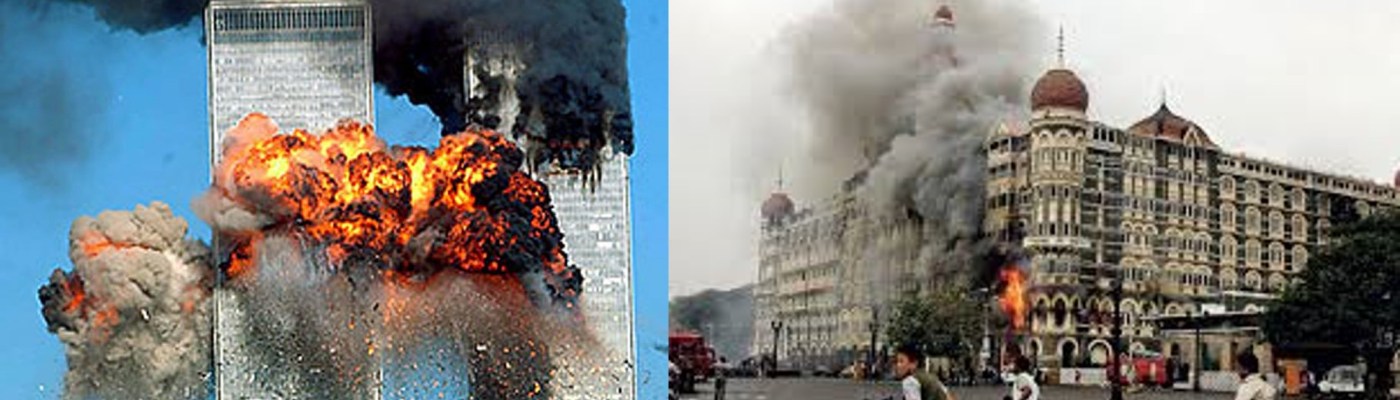
06-07-2018, Mumbai, India: Everywhere I looked, demons of the present [were] on the battlegrounds of one’s religious plane.

Good Morning Everyone. It’s the Friday Post on a rainy Friday morning. A string of rape incidents has shaken the conscience and the consciousness of this country. The rape of an 8-year old in Kathua, Jammu and Kashmir, united almost the entire nation. A recent one was in Mandsaur, where the perpetrator of the crime was a Muslim by faith.
Rape as a crime should know no religion – the rapist must be brought to justice at all costs. This is not just a fight for justice for the Mandsaur girl; this is a fight for justice for humanity.
However, I am not going to talk about rape in this post. This post is about the “fear psychosis” that grips us whenever we hear of a criminal incident. When I read the headline of the Mandsaur rape case, the first thought that came to my mind was a mixture of hope and fear – please let it not be a Muslim. A few days ago, a news report again surfaced of a driver trying to drive off with his female rider and the scuffle that ensued. Again, I had the same fear. Whenever I hear of a shooting incident in the US, my heart prays for a moment that the criminal not be a Muslim.
How it started
9/11 was the turning point for Muslims
There is this strange paranoia that has gripped the Muslims. This started somewhere around 2001 after the infamous Twin Towers attack. As the world started branding Muslims as terrorists and the war on terrorism became the most important event worldwide, Muslims became victims of Islamophobia. There were some terrorist attacks carried out by Muslims in the early days; as a result, the belief that “all terrorists are Muslims” got entrenched. (The truth is very different, at least in the US) The same happened in India too with a few incidents taking place in the country culminating with the dreaded 26th November attack on Mumbai.

Cases True and False helped build the Narrative
There was a phase of witch-hunts where many Muslim youths (example 1) were rounded up and accused of terrorism. Laws and acts like POTA came up. There were also a few incidents which were carried out by non-Muslims and designed to look like terrorist attacks carried out by Muslims. (Some famous ones include Malegaon and Mecca Masjid Hyderabad blast case which as of today have no clear convicts; these were also linked to non-Muslim outfits but the accused have not been found guilty) All of it kept permeating into people’ psyches. So much so that at some point in time, we started dreading the news of any criminal attack for the fear of our religion being associated with it.
The Scenario outside India
This wasn’t unique to me and this wasn’t unique to India. In her hugely successful book, “Muslim Girl”, Amani al-Khatahtbeh talks of having the same fear. A Muslim from the USA, she has gone through a lot more than I can imagine. In her intensely relatable book, this “fear psychosis” that she talks of clicks with me the most – the fear of what would happen whenever a notorious criminal act is associated with Muslims.

Understanding the Condition
A situation promoting paranoia
Psychosis is a clinical condition – an abnormal condition of the mind that results in difficulties telling what is real and what is not. Hence, calling the fear we have a “fear psychosis” is not entirely correct. What we have is a paranoia of sorts. Paranoia is a thinking that typically includes persecutory or beliefs of conspiracy concerning a perceived threat towards oneself. This is what fits the definition more perfectly.
The Role of Social Media
What adds fuel to this fire is the trolling on social media. Social media is filled with trolls – people who post inflammatory and digressive messages on online platforms to provoke others. In her books “I am a Troll”, Swati Chaturvedi talks of trolls in the Indian social media space. She highlights their methods and motivations. A large number spread anti-Muslim feelings, often attacking the religion as a whole whenever an incident occurs that involved Muslims. Showing scant disregard for the truth, they sometimes manufacture lies and accuse Muslims of crimes that they didn’t commit. (I have shared some examples later) Sometimes, when the victim is a Muslim, they also resort to victim shaming. (In the Kathua rape case, some people on the social media kept repeating that the girl was from a nomadic tribe who was taking up land belonging to the majority community)
This would not have been a worrying trend had it not been for WhatsApp. With simple messaging apps becoming popular, more and more Indians are able to access content over the internet. The interface is really simple and allows messages and videos to spread very quickly. As a result, it has become very easy for propaganda to spread to spread. This, in turn, makes us all the more afraid. The sheer magnitude at which hatred can spread can leave anyone worried.
False Accusations propagate the idea
There is also the worrying trend of naming Muslims for acts that were not committed by us. The Nirbhaya rape case of 2012 is an example. The gruesome and heart-wrenching act was carried out by six men, one of whom was a minor. The other five were non-Muslims but the identity of the minor was hidden. Rumours were spread that the minor was a Muslim, completely unsubstantiated. Similarly, a Kashmiri youth was detained in Delhi after returning from work in Saudi Arabia. Rumours were spread – I received it from a close and well-meaning friend – that he was a terrorist caught planting a bomb. While the grounds on which he was held were spurious by themselves, the allegation of him planting a bomb was completely randomly thrown at him and shared thousands of miles away.
The Role of Media
The role played by the media in such situations can’t be ignored. World over, terror attacks by Muslims get a lot of coverage. One study finds that attacks by Muslims are covered five times more often. In India, there are cases where the media has fallen to false news and reported events incorrectly. The Kasganj violence that took place this republic day is a prime example – senior journalists too fell to the propaganda. (Assuming they were not a part of the propaganda machinery in the first place)

This piece is a very personal one – things that I have felt. Yet, this is not a unique problem. I know friends who have felt it, I know relatives who also feel the same way. I don’t think I need to extrapolate here to call this a problem we have to face. I don’t really have any idea how I can solve this problem for myself, leave aside for others. I guess I will keep facing this fear every time I open a newspaper or app. Till then, live long and prosper.
This post has also been published here.
 A LAYMAN PERSPECTIVE