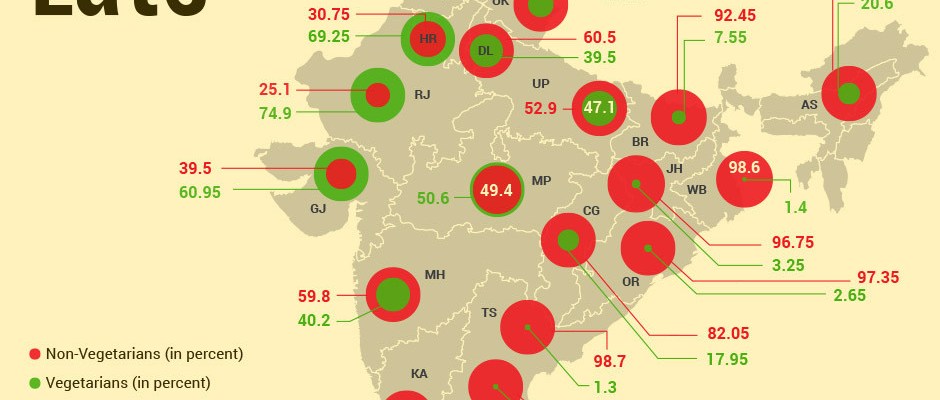
13-07-2018, Mumbai, India: The greatest trick the vegetarian Muslims ever pulled was convincing the world they didn’t exist.

Good Morning Everyone. It’s The Friday Post on a rainy Friday night. (I guess the Good Morning should have been a Good Night) A very interesting discussion came up a few days ago while my colleagues and I were sitting at our lunch table — are there any vegetarian Muslims? Or is it an oxymoron just like, as many presume, the vegetable biryani? One of my colleagues did know a vegetarian Muslim. I, on the other hand, knew none. So, how likely is it for a Muslim to be vegetarian?
Can Muslims be Vegetarians?
The Simple Answer is Yes
First of all, let’s understand if it’s allowed for a Muslim to be a vegetarian. The answer, excluding all caveats, is a yes. Vegetables are allowed for Muslims – and hence Muslims can be vegetarians. However, that’s not the definition of a vegetarian. A vegetarian is someone who abstains from meat – the flesh of animals. Can someone who abstains from meat be a Muslim? The answer, again excluding all caveats, is a yes.
Now, let’s include the caveats.
Vegetarians, the kind that abstains from meat for moral reasons, believe it’s inhumane to kill animals for their food. The roots of this belief can be religious or secular. They could be experiential as well. Also, people maybe vegetarians for other reasons – health a very prominent one. However, the meat of cattle is permitted in the Quran and various Hadeeth. Therefore, a Muslim who believes in them cannot consider eating meat as incorrect or immoral by itself. A belief against meat eating will be against the Quran.
That said, a Muslim can actually abstain from meat on moral grounds – say as a stand against the cruelty in the cattle industry. One can abstain from meat on other grounds as well. The scholars of the Hanafi school held that one should refrain from eating horses because they were essential for the army. Muslims can abstain from other forms of meat for similar reasons if they want. The only condition is that they can’t hold it haram or an inherent “bad thing” – for what is allowed by God as per Islamic belief cannot be considered prohibited.
Reasons for Vegetarianism
Health – Old Age or Diseases
What other reasons could make Muslims vegetarian – health definitely is one. My parents have been asked to eat as little meat as possible and they abide by the doctor’s advice. There could be specific conditions which require one to stop eating meat. As age advances, one might choose to decrease meat consumption.
Stand against Animal Cruelty – Ideological Opposition
A Muslim friend I knew gave up meat after seeing videos of animal cruelty. This could be a strong motivator – I know a fair number of non-Muslim friends who did the same. Of course, the number of friends who are okay with eating meat as long as they don’t get to see the slaughtering of animals is much higher.
Availability of Halal Meat
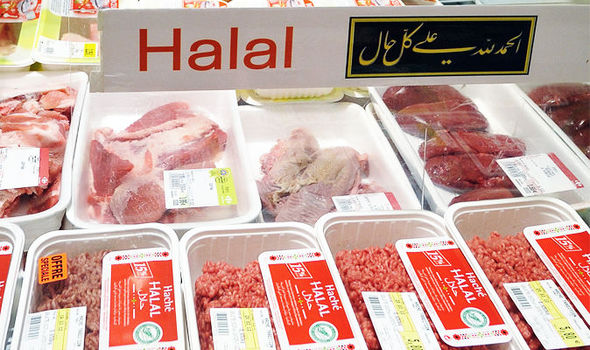
Availability of halal meat is another key factor – I myself had to stay in places where there was no meat available. A friend recently went to East Asia and had to sustain on biscuits etc. because he couldn’t find halal meat.
Spiritual Practice
Some Muslims also practice vegetarianism as a means of sacrifice and self-control. The idea of giving up pleasures for the sake of God is entrenched in many religions. Some practitioners of religion also impose upon themselves – and themselves only it should be – additional giving up of legal pleasures on a temporary or permanent basis. This idea could be another factor towards Muslims adopting vegetarianism.
CHOICE
A very important reason will be – and that’s why I have saved it for the last – choice. I can just choose to be a vegetarian because of the taste or economics or something else – no moral compulsion needed. I personally don’t know anyone of this disposition but I won’t rule out the possibility of such people.
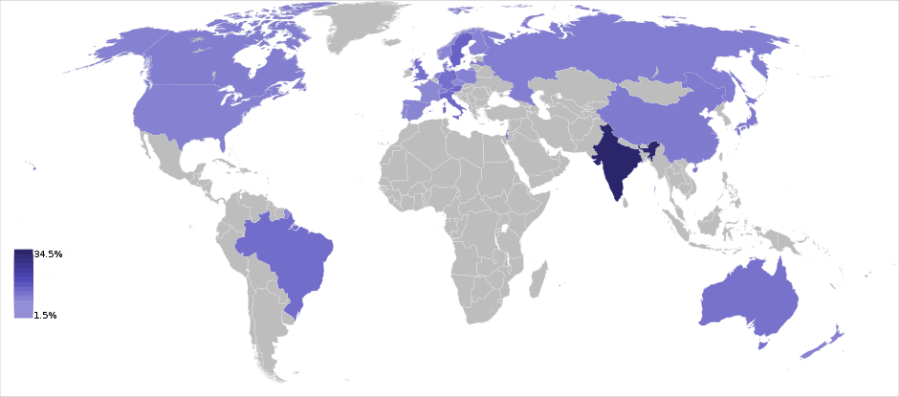
An interesting exercise would be how many vegetarian Muslims are there in the world? How many of them are in India? What influence has India had had on the eating habits of Muslims?

While the numerical analysis will be a purely guessing exercise, the effect of Indian culture on Muslim food habits cannot be ignored. Whereas our coreligionists in Middle East eat camel and sheep, we are fonder of goat and chicken. (Let’s steer clear of the beef debate here for now) That’s because of the abundance of the latter set of animals in India as opposed to camels and sheep. Not just in terms of what we eat, the Indian influence is very clearly visible in the cooking styles. Perhaps I will write a post on the Indian Muslim cooking someday. Till then, live long and prosper!
This post has also been published here.
 A LAYMAN PERSPECTIVE
