
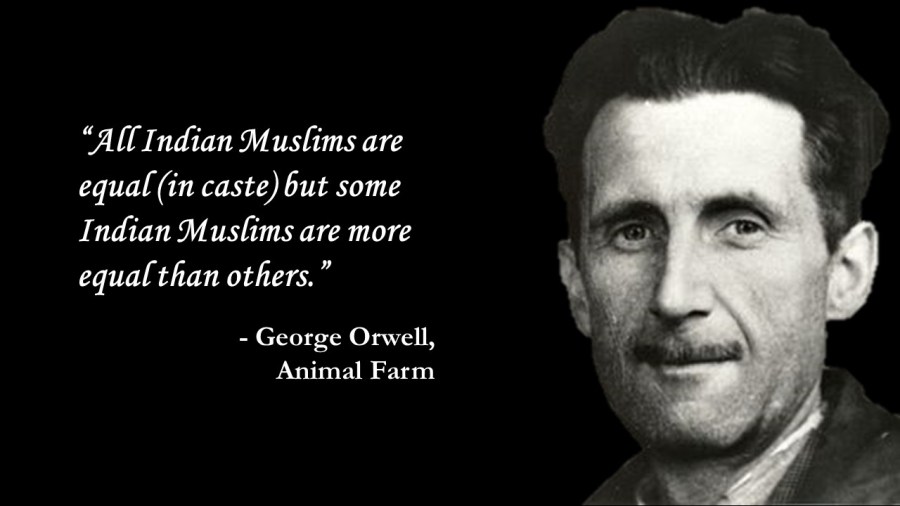
03-08-2018, Mumbai, India: All Indian Muslims are equal (in caste) but some Indian Muslims are more equal than others.
Good Morning Everyone. It’s the Friday Post on a warm Friday morning. Today, let’s talk about caste. Specifically, let’s talk about caste in the Indian Muslim society. It has for long remained an unacknowledged truth among us. So much so that the first instance I heard of it, I was surprised; this surprise is not an experience unique to me. I intend to talk about this over time, looking at it from various perspectives that I have encountered and will in the future.
Today, I will be conducting a more or less academic exercise establishing some basic facts.
The Caste System in India
What is the caste system?
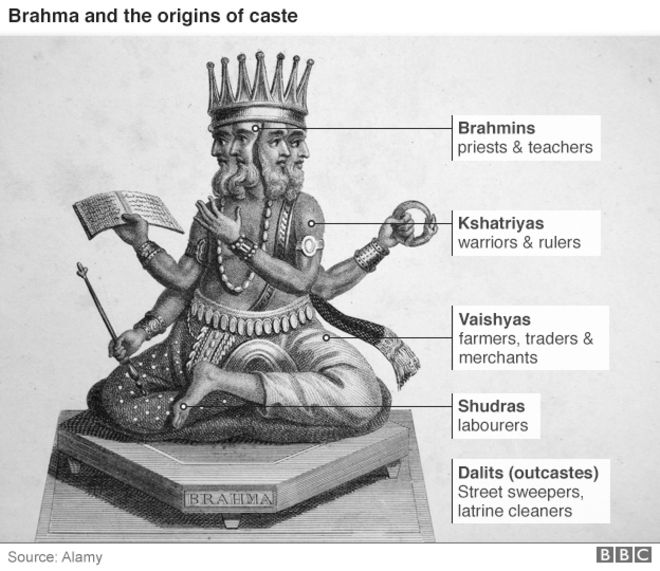
Ancient Indian society from the Vedic times was divided into four varna:
- Brahmana – the priestly and the scholarly class
- Kshatriya – the political rulers and the soldiers
- Vaishya – the traders and merchants
- Shudra – labourers, peasants, servants, et cetera
The untouchables were people who did menial labour and were outside the varna system. These people are considered outside the Hindu way of life by some scholars even though this is debatable. A few scholars of the subject have considered this system to be the European understanding of caste system and hence not a fair representation.
The next level of classification was the jati system. Each of these varna was further classified into jati. An understanding of this system is not as easy as the varna system because the jati and its hierarchy are influenced by local factors.
The strengthening of the caste hierarchy
The varna system was formed in the Vedic ages in India. Initially a hierarchical and occupational system, it became hereditary over time. There was some time to go before it morphed into an oppressive system. The jati were also hereditary and developed an inherent hierarchy over time. This resulted in people of the same varna looking down upon or discriminating against each other.
The hierarchy and oppression of the caste system are not new phenomena. References are often made to the Manusmriti as an ancient text that advocated the discrimination against lower castes. The patronisation of Buddhism and Jainism by the Vaishya traders is often explained along the lines of caste inferiority. The discrimination continued, and we can also say intensified, with the coming of the foreign powers. Both the Abrahamic religions that entered India – Islam and Christianity – adopted the caste system in various ways instead of abolishing it.
Caste System outside India
Even though no other religion has castes defined like Hinduism, the caste system has prevailed in one form or the other across the world. It won’t be a stretch of imagination to consider racism and caste very similar to each other. While caste has been very prevalent in South East Asia, there have been forms of it practised in Africa, East Asia, and Europe too.
The Caste System in Islam
The Islamic Law
Islam fundamentally decries the caste system. The last sermon of the prophet stressed the equality of all people irrespective of their race and lineage.
There is no superiority for an Arab over a non-Arab and for a non-Arab over an Arab, nor for the white over the black nor for the black over the white except in God-consciousness. – Prophet Muhammad (sallallahualaiwasallam)
Islamic society outside the subcontinent doesn’t have a very strong concept of caste. Classes, as always and everywhere, are present in all communities. Islamic societies have been tribal and there are strong feudal loyalties. However, this hasn’t spurred the growth of a hierarchical and hereditary caste system in other Islamic countries.

The Indian Situation
There are two main reasons for the existence of caste in South East Asian Muslim communities – intermingling and conversions. While intermingling is a simple concept – as communities live in close proximity, they pick up traits of one another both good and small – to understand, conversions have led to a slightly stratified Muslim community. Scholars identify three major castes, the equivalent of Varna, in Indian Muslim community.
- Ashraf – the upper castes, mostly those claiming descent from foreigners who came to India. These include the Sayyid (descendants of the prophets), the shaikh, and the Pathan. The other two can be descendants of Arabs, Turks, or the Central Asians. The high caste converts also can be clubbed here.
- Ajlaf – the commoners who converted to Islam. The weavers, agriculturists, traders, etc. fall in this category. The Ansari are a very populous sub-caste in this category.
- Arzal – the lower caste converts from the Dalit. These include sub-castes like washermen (dhobi) and barbers (hajam).
These classifications are slightly fluid as the Ashraf were originally believed to be only people of foreign descent but a large population of high-caste converts also consider themselves above the Ansari and the Qureishi (butchers). As already specified, there are a lot of sub-castes within the major castes resembling the jati system. In my experience, Muslims hardly refer to themselves as Ashraf or Ajlaf or Arzal. Unlike the Hindu community, Muslims are almost entirely divided along their jati. You will find their sub-caste identity completely consuming whatever caste identity scholars have identified.
A slightly interesting thing to note here is that the better-off and stronger Ajlaf, the traders, farmers, weavers and the butchers, chose the names Ansari and the Qureishi for themselves. Quraish was the tribe of the Prophet sallallahualaihiwasallam. This was the dominant tribe in Makkah. The Ansar were the dominant tribe in Madinah. Madinah was the city the prophet migrated and the epicentre of Islam where the Prophet’s tomb and mosque still stand. This, in my opinion, showcases their desire to be seen as having some connection to Arabia and hence seen as high caste.
Some salient points about Indian Muslim Caste System
The Partition and its effects
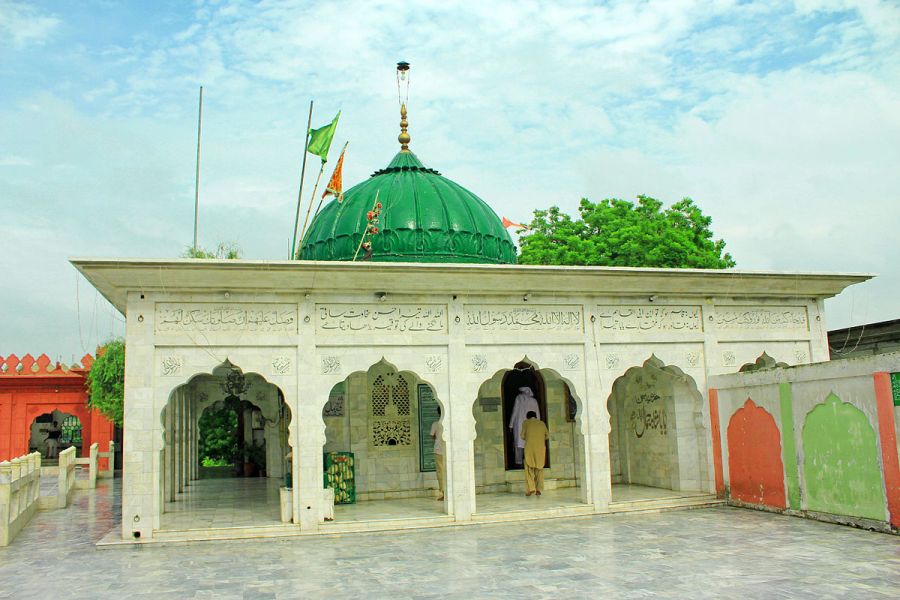
The partition altered the caste dynamics of the country in some small but significant ways. The people who migrated were mostly the people close to the borders – Punjabis and Bengalis – and the people with enough resources to migrate. The poor are perhaps destined to stay poor wherever they go. Thus, the numerical and economic superiority of the Shaikh, Pathan, and Sayyid was slightly dented and the Ansari gained strength. A very good example is the tomb of Shah Jamal in Aligarh who was a Sayyid. He had a lot of Ansari followers too. With the management of his tomb in the hands of his descendants, his Ansari followers set up an alternate management system and his day of death, Urs, was celebrated twice a year. The Ansari are also gaining political strength; Hamid Ansari was the Vice President of the country.
Endogamy
Perhaps the single greatest factor that keeps the caste system among Muslims alive even today is endogamy. Muslims still marry within their sub-caste. This is augmented by the fact that Muslims in the subcontinent follow the Hanafi school of jurisprudence. This school, as opposed to the remaining three Sunni schools and the modern Wahabi-Salafi followers, have the concept of Kufw according to which a marriage can be nullified if it is between two people of varying social status. Effectively, if I marry someone and her parents feel that my family is not a match for hers economically or because of lineage, they can nullify the marriage. Though rarely practised – I have never seen, heard, or read of any such case – this practice supports the hierarchical nature of society. Indian Muslims simply adopted Kufw as a substitute of caste; I should know this since my family once used this to reason with me why I should marry within my sub-caste. (Being more educated – religiously and secularly – than all of them, I find it easy to shut them down.)
Conclusion
This section is in no way over. The post, however, is. Readers can meanwhile read and enjoy this beautiful song written by Baba Bulle Shah on the caste system and how the greatness of a human being is by her or his actions and not birth. Caste in India has had volumes written about it. I will get down to doing the same soon. Till then, live long and prosper.
This post has also been published here.
 A LAYMAN PERSPECTIVE
Quite an insightful read. Loved it
Hey. Thanks a lot. Hope to keep talking of such stuff in the future too. By the way, no travel updates from you in quite some time?